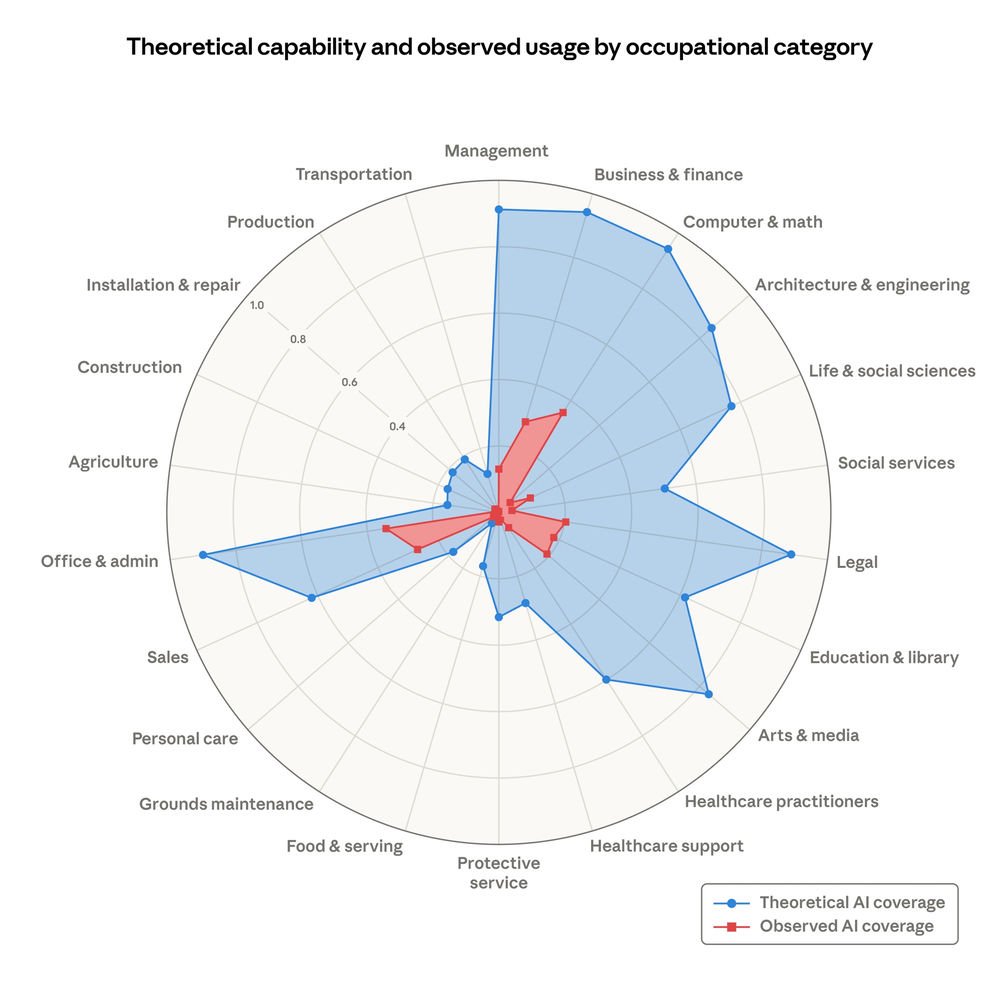
In March 2026, Anthropic published a study on the impact of artificial intelligence on the labour market, "Labor Market Impacts of AI", based on real usage data from Claude. The study includes a radar chart that shows, by occupational category, the difference between theoretical AI coverage (what AI could do) and observed coverage (what people actually do with it). That chart made the rounds on LinkedIn, was reposted hundreds of times, and generated headlines about how AI will replace managers, finance professionals, lawyers, and administrative staff.
The problem is that most people who shared it did not read the study. Or skimmed it at best.
The study everyone shared and almost nobody read
The numbers are impressive on the surface, theoretical AI coverage exceeds 90% in categories such as Computer & Math, Business & Finance, and Management. Looking only at this, it seems like nine out of ten tasks in these professions can be done by AI but observed coverage — what people actually do with Claude — sits between 20 and 36% in those same categories. There is a huge gap between what AI can do and what is actually being done.
There is also a methodological issue, observability depends on usage. If in a given profession people do not use AI, the study concludes that exposure is low but that does not mean AI cannot do that work, it means nobody is using it for that purpose — these are different things.
It also works the other way around: if a manager uses Claude mainly to write emails and review documents, the superficial reading is that AI can replace managers but managing is not writing emails. It is making decisions with incomplete information, dealing with people, navigating political and institutional context. AI helps with parts of the work but that does not make the work replaceable, it makes it different.
The study itself says that it found no systematic increase in unemployment among the most exposed workers. It says the most recent trend points towards more augmentation (AI collaborating with humans) than automation (AI replacing humans) and it says that real coverage is still a fraction of what is theoretically possible.
None of this invalidates the study! It is serious work and probably the best that currently exists on actual AI usage in the labour market, but the reading that caught on says more about those who shared it than about the study itself.
What happens if we apply this logic to public administration
That said, the study can serve as a starting point for a discussion worth having: what if theoretical coverage approaches observed coverage? What if, over the next few years, AI gradually absorbs a significant part of the administrative, analytical, screening, and document-validation tasks that today occupy thousands of people in public administration?
In the private sector, if a company discovers it can do the same with fewer people, it adjusts. It lays off, reorganises, hires different profiles — it can be painful, it can be poorly done, but the mechanism exists. In the Portuguese public sector, that mechanism practically does not exist — a civil servant with a permanent contract is not dismissed because their function was automated and, when an entity is dissolved, workers are reassigned to other bodies. They do not become unemployed, they go somewhere else, often without a clear role waiting for them.
The question, then, is not "how many jobs will disappear in public administration?" but "what does public administration do with the capacity that is freed up?"
The paradox: we need more people and we may have too many
Portugal has roughly 766 thousand civil servants, representing about 14.6% of the employed population and, compared with the OECD, we are below the average. The Nordic countries, which score better on service-quality indicators, have percentages above 25% — in aggregate terms, we are not a country with an excess of civil servants.
At the same time, the workforce is ageing rapidly, there are recruitment competitions that go unfilled, and there are areas such as technology, health, and engineering where public administration cannot compete with the private sector for qualified talent. Right now, the visible problem is a shortage of people.
But if we start seriously automating administrative and bureaucratic work, we may discover that in certain roles we have more people than needed. Not everywhere, not uniformly, but enough to create a real problem: people whose main function has ceased to exist, in a system that does not know what to give them to do.
The attraction problem
Over the past few years, the private sector has been wrestling with how to offer what the new generations look for — a sense of mission, real-world impact, purpose beyond shareholder returns. It is a difficult question for something that, by its nature, exists to generate returns. Public administration, by the nature of what it does, already has this. Working on modernising a public service, in health, education, or justice, is work with direct impact on people's lives, and the hours, all things considered, are more predictable than in many consultancies or startups.
The problem is that this advantage only works if the basics are not broken. A senior officer who enters the civil service with a salary that barely covers rent in Lisbon does not stay for the mission, they stay until they find an alternative. For this to work in practice the minimum needs to be in place — salaries that allow people to live with breathing room, progression that does not depend on decades of waiting, and autonomy for those who demonstrate capability.
The exit problem
There is another side to this conversation.
If AI frees up capacity and there are people whose main function has been absorbed, the natural path is reskilling — it makes sense on paper. But in practice, reskilling requires two things: that the organisation has a plan and that the people want it.
The plan is difficult because public administration is busy functioning, there is no time or structure for serious reskilling programmes when day-to-day operations already consume everything. The change management that would be needed is not happening and, at the speed everything is moving, it probably will not happen in time.
And even if there were a plan, a question remains: reskill to do what? If the dominant narrative is that AI replaces everything, what are we reskilling for? It is not clear what the new jobs are, nor whether they will exist long enough to justify the investment.
In cases where reskilling is not possible — because the person does not want to, because they do not have the profile, because the function has disappeared — what do you do? In the private sector, you lay them off. In the public sector, you do not.
The abolition of institutes and mission structures is often presented as "reducing the state" but, in practice, the workers do not disappear, they are redistributed. The cost to public finances may even remain the same — what changes is where people are sitting, not how many people there are.
Neither as it is, nor like the private sector
I do not have a clean solution for this but I know that the current model — where entry is slow and exit is nearly impossible — does not work. And copying the private sector model does not work either, because the public service is not a company and cannot be managed as one.
What seems necessary to me is rethinking both sides. On entry, making public administration competitive for those who bring value; on exit, creating mechanisms that do not exist today, that are not the free dismissal of the private sector but are also not the total immovability we have now. Something that allows managing surplus with dignity, without pretending the problem does not exist.
AI will not replace civil servants, at least not in the way LinkedIn headlines suggest, but it will expose that public administration has people in roles that can be automated, while at the same time being unable to hire for the roles it actually needs — and as long as the entry and exit model is not rethought, that tension will only grow.